

Introduction: The Battle for Working Capital
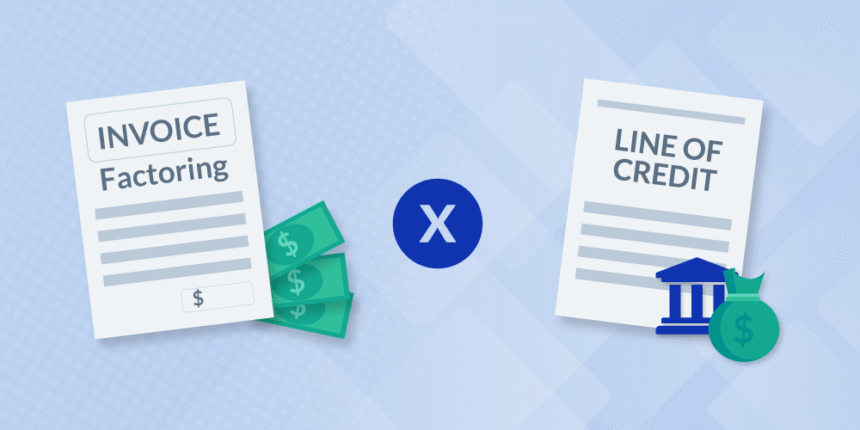
In the volatile economic landscape of late 2025, accessing reliable working capital is the lifeblood of any small to mid-sized enterprise (SME). Whether you are managing a fleet of trucks in the transportation industry, overseeing a staffing agency with weekly payroll demands, or running a manufacturing plant waiting on net-60 payments, the gap between invoicing and actual revenue collection can be crippling. This cash flow gap is where two financial titans clash: invoice factoring and business lines of credit.
- Introduction: The Battle for Working Capital
- Current Market Snapshot: November 28, 2025
- Deep Dive: What is Invoice Factoring?
- Deep Dive: What is a Business Line of Credit?
- Head-to-Head: The Cost Comparison Scenarios
- The Qualification Hurdle: Credit vs. Collateral
- Operational Impact: Control and Privacy
- Trending Financial Keywords & 2025 Innovations
- Sector-Specific Analysis: Who Wins Where?
- The “Soft Costs” of Financing
- Summary: Decision Matrix
- Conclusion: The Strategic Choice
For business owners, the choice often boils down to cost and speed. Which financing option preserves your profit margins? Which provides the fastest business funding without shackling your company with unmanageable debt? In this comprehensive guide, we dissect the true costs of accounts receivable financing versus revolving credit lines. We will move beyond the advertised rates to expose hidden fees, “soft” costs, and the operational impacts of each, providing you with the financial intelligence needed to make the right choice for your fiscal health.
Current Market Snapshot: November 28, 2025
Before diving into the mechanics, let’s look at the live market conditions affecting small business loan rates and factoring fees today. As the Federal Reserve adjusts policies to combat lingering inflation, borrowing costs have shifted.
Daily Rate Monitor (November 28, 2025):
- Prime Rate: 7.50% (Benchmark for most lines of credit)
- Secured Business Line of Credit: Prime + 2.0% to 4.5% (Approx. 9.5% – 12.0% APR)
- Unsecured Business Line of Credit: 14.0% – 35.0% APR (Dependent on FICO and annual revenue)
- Invoice Factoring Discount Rate: 1.75% – 4.50% per 30 days (Effective APR: 21% – 54%)
- SBA 7(a) Line of Credit: Prime + 2.25% to 4.75% (Capped options available)
Analysis: While a commercial line of credit technically offers a lower Annual Percentage Rate (APR) for prime borrowers, invoice factoring approval rates remain significantly higher for businesses with lower credit scores but high-value B2B invoices.
Deep Dive: What is Invoice Factoring?
Invoice factoring, often referred to as accounts receivable factoring, is not a loan. It is the sale of a financial asset. When you utilize factoring, you sell your outstanding B2B invoices to a third-party financing company (the factor) at a discount. This provides immediate cash flow for small businesses without adding liabilities to your balance sheet.
How the Cost Structure Works
To determine if this is cheaper, you must understand the “Factor Rate” vs. APR.
- The Advance Rate: The factor typically advances 80% to 95% of the invoice value within 24 hours.
- The Discount Rate (Factor Fee): This is the fee charged for the service, usually between 1.5% and 5% of the invoice face value.
- The Term: Fees are often tiered based on how long the customer takes to pay (e.g., 1.5% for the first 30 days, plus 0.5% for every 10 days thereafter).
Hidden Costs in Factoring
- Origination Fees: Setup costs for the account.
- Lockbox Fees: Monthly charges for the administration of the collection account.
- Unused Line Fees: Some factors require a minimum volume of invoices monthly; failing to meet this can trigger penalties.
- Credit Check Fees: Costs associated with vetting your customers’ creditworthiness.
Best Use Cases for Factoring
- Trucking and Transportation: High fuel costs and slow-paying shippers make freight factoring essential.
- Staffing Agencies: Weekly payroll obligations often clash with net-30 or net-60 client terms.
- Government Contractors: Long payment cycles from government entities can be bridged effectively.
Deep Dive: What is a Business Line of Credit?
A business line of credit (LOC) is a revolving debt facility. Much like a high-limit credit card, you are approved for a maximum amount (e.g., $100,000). You can draw funds as needed, repay them, and draw again. Interest is paid only on the amount utilized, not the total limit.
How the Cost Structure Works
The cost is primarily driven by the Annual Percentage Rate (APR), which consists of the index (Prime Rate) plus a margin determined by the lender’s risk assessment.
- Simple Interest: Most LOCs charge simple interest on the outstanding daily balance.
- Compound Frequency: Interest may compound monthly or weekly, slightly increasing the effective cost.
Hidden Costs in Lines of Credit
- Annual Maintenance Fees: Lenders often charge $150 to $500 annually just to keep the line open.
- Draw Fees: Transaction fees every time you access funds (typically 1-2%).
- Inactivity Fees: Penalties for not using the line for a set period (e.g., 6 months).
- Prepayment Penalties: Rare for lines of credit, but common in term loans—always check the fine print.
Best Use Cases for Lines of Credit
- Inventory Purchasing: Buying bulk stock at a discount before the busy season.
- Emergency Repairs: Fixing critical equipment without draining cash reserves.
- Seasonal Cash Flow Management: Smoothing out revenue dips in off-peak months.
Head-to-Head: The Cost Comparison Scenarios
Let’s run the math. This is where the “cheaper” option reveals itself. We will compare the cost of financing $50,000 for 30 days.
Scenario A: The Invoice Factoring Route
- Invoice Value: $50,000
- Advance Rate: 90% ($45,000 received upfront)
- Factor Rate: 2.5% flat fee for 30 days.
- Processing Fee: $50 wire fee.
Total Cost: $1,250 (2.5% of $50k) + $50 = $1,300.
Effective APR: ($1,300 / $45,000) x (365 / 30) = 35.1% APR.
Scenario B: The Business Line of Credit Route
- Amount Drawn: $50,000
- Interest Rate: 12% APR (Prime + 4.5% for an average borrower).
- Draw Fee: 1% ($500).
Interest Cost: ($50,000 x 0.12) / 12 months = $500.
Total Cost: $500 (Interest) + $500 (Draw Fee) = $1,000.
Effective Cost: $1,000.
Winner: In this scenario, the business line of credit is cheaper by $300. However, this assumes you qualify for a 12% APR. If you are a subprime borrower with a bad credit business loan rate of 40%, the interest cost triples, making factoring competitive again.
The Qualification Hurdle: Credit vs. Collateral
Cost is irrelevant if you cannot qualify. This is the primary driver for high-volume searches related to “no credit check business loans” and “bad credit commercial financing.”
Qualifying for a Line of Credit
Banks and online lenders view a line of credit as a riskier product than a term loan because it is unsecured or effectively “blanket” secured.
- Minimum Credit Score: Generally 680+ for bank rates; 600+ for fintech lenders.
- Time in Business: Typically 2+ years required.
- Revenue Requirements: Annual gross revenue of $250,000+.
- Documentation: Tax returns, P&L statements, and balance sheets are mandatory.
Qualifying for Invoice Factoring
Factoring companies are less concerned with your credit score and more concerned with your client’s creditworthiness.
- Minimum Credit Score: often 500+ (or non-existent).
- Time in Business: Can be a startup (0-6 months).
- Revenue Requirements: Must have verified B2B invoices.
- Documentation: Aging reports, articles of incorporation, and valid invoices.
The Verdict: If you have excellent credit, a line of credit is cheaper. If you have poor credit or are a startup, factoring is often the only accessible option, making it the “cheaper” alternative to failing due to lack of cash.
Operational Impact: Control and Privacy
Beyond the math, there is a cost to your reputation and operational freedom.
Customer Perception (Factoring):
In traditional factoring (notification factoring), your customers are notified to pay the factoring company directly.
- Risk: Customers may perceive your business as cash-poor.
- Mitigation: Non-notification factoring (white-label factoring) allows you to keep the arrangement private, though it typically requires higher revenue volumes.
Operational Freedom (Line of Credit):
A line of credit is invisible to your customers. You maintain full control over your accounts receivable and collection processes.
- Benefit: You preserve direct relationships with your clients.
- Risk: You bear the full burden of collections. If a client doesn’t pay, you still owe the bank principal plus interest.
Trending Financial Keywords & 2025 Innovations
The financing landscape is evolving. When searching for capital, be aware of these trending terms and technologies that are reshaping costs.
1. Embedded Finance
Major platforms (like Shopify, Amazon, or QuickBooks) are now offering embedded lending. These are pre-approved credit lines based on your transaction history within the platform.
- Pros: Instant approval, high convenience.
- Cons: Rates are often higher than traditional banks; repayment is deducted automatically from daily sales.
2. AI-Underwritten Loans
Fintech lenders are using Artificial Intelligence to analyze thousands of data points (banking activity, social sentiment, shipping data) to approve fast business loans in minutes.
- Impact: This has opened up lines of credit to younger businesses that lack 2 years of tax returns, albeit at a premium rate.
3. Spot Factoring (Single Invoice Factoring)
Unlike whole-ledger factoring where you must factor all invoices, spot factoring allows you to finance a single, large invoice.
- Cost: Fees are higher (3-5% flat), but you avoid long-term contracts. This is a high-volume search term for seasonal businesses.
Sector-Specific Analysis: Who Wins Where?
Construction & Contracting
- Challenge: High upfront material costs; slow pay on completed milestones.
- Recommendation: Construction factoring is expensive due to “paid-when-paid” clauses. A line of credit is superior here if available. If not, look for “mobilization funding.”
Freight & Logistics
- Challenge: Fuel and repairs are immediate; brokers pay in 30-45 days.
- Recommendation: Freight factoring is the industry standard. The 2-3% fee is often outweighed by the benefit of fuel cards and back-office support provided by the factor.
Manufacturing & Wholesale
- Challenge: Long production cycles.
- Recommendation: Asset-based lending (ABL). This is a hybrid. It is a revolving line of credit secured by the value of inventory and receivables. Rates are often lower than pure factoring, closer to prime + 3%.
The “Soft Costs” of Financing
When calculating “cheapness,” do not ignore the soft costs:
- Time to Funding:
- Factoring: 24-48 hours. (Opportunity cost: Low)
- Bank Line of Credit: 2-6 weeks. (Opportunity cost: High – could lose a contract waiting).
- Fintech Line of Credit: 24-72 hours. (Opportunity cost: Low).
- Flexibility:
- Factoring: Scales with sales. If you double your sales, your funding limit doubles automatically.
- Line of Credit: Fixed limit. To increase it, you must re-apply and undergo credit underwriting again.
Summary: Decision Matrix
Use this quick guide to determine which path is most cost-effective for your specific situation.
| Feature | Invoice Factoring | Business Line of Credit |
| Primary Cost Metric | Factor Rate (1-5% per invoice) | APR (8% – 35% annual) |
| Best For | B2B with slow-paying clients | Short-term cash flow needs |
| Credit Requirement | Low / Based on Customer | High / Based on Business Owner |
| Collateral | The Invoice itself | General Business Assets / Personal Guarantee |
| Speed | Fast (1-2 days) | Varies (3 days to 4 weeks) |
| Scalability | Unlimited (Linked to sales) | Limited (Fixed credit limit) |
| Debt on Balance Sheet | No (It’s an asset sale) | Yes (It’s a liability) |
Conclusion: The Strategic Choice
So, invoice factoring vs. business lines of credit: which is cheaper?
Strictly by the numbers, a traditional bank business line of credit is almost always the cheaper option, with APRs ranging from 9% to 15%. If your business has the credit score (680+), the history (2+ years), and the patience to navigate the application process, you should secure a line of credit. It is the gold standard for cheap working capital.
However, “cheap” is relative to accessibility. If you are a high-growth startup, have a bruised credit history, or operate in an industry where customers take 60+ days to pay, the effective cost of a line of credit might be infinite—because you cannot get one. In these cases, invoice factoring, despite its higher APR (20-40%), is the strategic winner. It unlocks the capital trapped in your balance sheet, allowing you to take on new orders, meet payroll, and grow.
The most expensive money is the money you can’t access when you need it most. Evaluate your eligibility first, then optimize for cost.